Building a bedroom that helps you recover
For years my bedroom was a storage closet that I happened to sleep in. Clothes draped over the chair, a laptop somewhere near the pillow, a small lamp that did not quite reach the corners. Then I started keeping a wellness diary, and the first pattern that became impossible to ignore was this: the nights I described as “deep” almost always happened in rooms that felt quiet, and the nights I described as “shallow” almost always happened in rooms that felt cluttered.
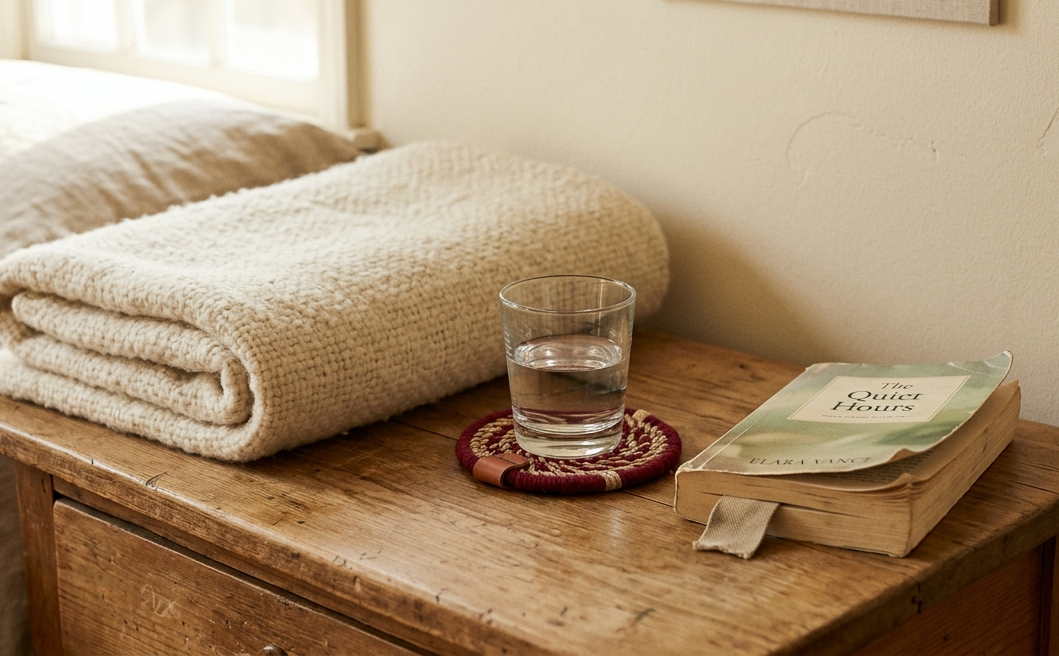
The room as a quiet partner in your rest
It is easy to think of rest as something you do. A wellness diary, kept honestly over a few months, suggests that rest is also something a room offers you. The walls, the air, the light, the small noises — together they make a kind of welcome. A welcoming room does not have to be expensive or stylish. It mostly has to be settled.
General guidance from the World Health Organization and from popular health writers like the Harvard health publications repeatedly underline the same simple idea: the environment you sleep in is one of the most controllable parts of your overall well-being. It is rarely the most exciting recommendation, which is why we mostly skip it.
“You cannot out-routine a chaotic bedroom. Sooner or later the room wins.”
Light: the loudest invisible thing
The single most useful change I made was to take light seriously. Not in a dramatic way — I did not install blackout shutters or invest in an army of candles. I just learned to dim things earlier than I thought I needed to.
- One hour before sleep, lower the ceiling lights. Use side lamps with warm bulbs instead.
- Move screens out of arm’s reach. If a phone has to live in the room, place it across the room, screen down.
- Make the room genuinely dark to sleep in. If full curtains are not an option, a soft eye mask is a small kindness.
According to general well-being guidance, our bodies use light cues to decide what time it is. When we send mixed signals, the body negotiates rather than rests.
Texture: what the body lies on, and against
The diary made me notice that the nights I felt scratchy and tossed often involved a pillow I was no longer fond of, or sheets that were rough but I kept because they were “fine”. Texture is not a luxury question; it is a practical one.
Pillow
If you wake up and the first thing you do is rearrange your neck, your pillow is probably wrong for you. It does not need to be expensive. It needs to support the angle your shoulder asks for.
Sheets
Choose by feel, not by thread count. The sheets that calm you down the moment you slip into them are the right sheets.
Blanket weight
Some bodies want a heavier weight, some want a lighter one. The diary is a useful place to note which season your blanket suits and which it does not.
Air and temperature: the room’s mood
A small, quiet change that made a big difference: opening the bedroom window for ten minutes before bed, even on cold evenings. The room cools, the air refreshes, and the body reads the temperature shift as a soft invitation to settle.
If you cannot fully open a window, a small gap for fifteen minutes still helps the air feel less stale. A cooler room is, for most sleepers, a more restful one.
Noise, and the gentler kind of quiet
True silence can be uncomfortable for some sleepers; mine certainly is. After noticing that on diary nights with “city quiet” I slept better than on “perfect silence” nights, I added a small white-noise speaker. It runs softly through the night, and it has become one of the most boring, most useful additions to my room.
If you share a room with a partner or a pet, the diary becomes especially useful: it gives you a polite way to talk about which small sounds genuinely affect your rest, and which you have learned to tune out.
The evening ritual: how you enter the room matters
A room can be ready, and you can still arrive into it scattered. Over time I have built a short, plain entry ritual:
- Tidy three things. Not a deep clean — three items put away. It signals to the brain that the day is closing.
- Lower the lights. Side lamps only.
- Open the window briefly. Even in winter.
- One slow page. Read one page of a book that has nothing to do with my work.
- Brief diary note. One line about how the day actually felt.
The ritual is on purpose unimpressive. You should be able to do it on the most tired evening of the year.
What I quietly moved out of the bedroom
My diary slowly made the case for moving a few things out of the room entirely:
- Work papers, especially ones with unfinished tasks visible on top.
- The laundry basket, which seemed to whisper its own to-do list.
- Loud-coloured décor on the wall directly facing the bed.
- The phone charger, which lived suspiciously close to the pillow.
None of these moves was dramatic. Together, they made the room feel more like a long exhale than a corner of the apartment.
Small additions that earn their place
On the other hand, a few small additions have repeatedly shown up as “good night” entries in my diary: a soft rug for bare feet on the way to bed, a glass of water already on the nightstand, a hand cream that smells calm, a folded blanket at the foot of the bed for the cool early hours.
Each is tiny. Together they make the room feel cared for, which makes me feel cared for, which is exactly what a recovery room is supposed to do.
Frequently asked questions
Do I need to redecorate to get most of the benefit?
No. Most of the changes that show up in readers’ diaries are free or close to free — light, air, clutter, and the evening ritual.
What if I live in a studio and the bedroom is also the office?
A simple visual divider — a folding screen, a curtain, even a tall plant — can do a lot of the work. You are not trying to fool yourself, just to soften the transition.
Should I really keep my phone out of the bedroom?
If you can, yes. If you cannot, placing it across the room with the screen down is a useful compromise.
How long until I notice a difference?
In my diary, most of the bedroom changes show up within the first two weeks. The evening ritual takes a little longer to settle into a habit.
Letters from the journal
One thoughtful note every other Sunday — slow-paced reflections, small habit ideas, and the occasional bookmark. No spam. Unsubscribe whenever you like.
Why yearly self-check-ins matter (and how I quietly do mine)
I never used to do a yearly review. New Year felt loud, January felt grey, and any “reflection” I attempted turned into a list of things I was going to do better, which made me feel worse. The shift came when I stopped thinking of the yearly self-check-in as a performance review and started thinking of it as a long, quiet conversation with myself.
What a yearly self-check-in actually is
A yearly self-check-in is a slow look at how the last twelve months have actually felt — in your body, in your relationships, in your time. It is not a productivity audit. It is not a goal-setting workshop. It is closer to the kind of conversation you would have with an old friend who has not seen you for a year and asks, in earnest, “How have you really been?”
General guidance from public-health writers, including the popular Harvard health letters, often makes the point that an honest periodic look at your habits supports long-term well-being more than dramatic one-off changes. The yearly self-check-in is a gentle, non-clinical version of that idea.
“A year is too long a story to read all at once. The check-in is the table of contents.”
Why yearly, not monthly or never
Monthly reviews can become another tiny stress on the calendar. “Never” is what most of us actually do, and it leaves us a little blind. Yearly is long enough to see real shape — the trip that lit you up, the project that quietly took a toll — and short enough that the details are still in reach.
- It sits naturally near a birthday or the change of seasons.
- It is rare enough to feel meaningful rather than routine.
- It can be repeated for many years without becoming a chore.
How I quietly do mine
My yearly check-in fits in one quiet morning, usually in the first week of a new season. I bring a notebook, my last twelve months of wellness-diary entries, and a long mug of tea. Nothing else. No spreadsheets, no goal templates. Here is the soft structure I have grown into.
1. A long re-read
I read back through my short diary entries from the last year, no editing, no judging. I just notice which months feel heavier and which feel lighter when I read them now.
2. Four honest questions
I write the same four questions every year:
- What did the last year ask of me that I did not expect?
- What gave me energy more often than I realised at the time?
- What quietly drained me, even though it looked fine on paper?
- What do I want a little more of, and a little less of, going forward?
The answers are usually short. They are almost always more useful than any goal list I could write from scratch.
3. A small “kindnesses owed” list
I write down the people who carried a part of my year quietly — the friend who replied to every late text, the colleague who covered for me without making a fuss. I write one small kindness I owe each of them. Then, over the next month, I try to actually do them.
If you have never done a yearly self-check-in, try a “half” one first. Look back over the last six months instead of twelve, using the four questions above. It is a gentler starting point.
4. The body chapter
I dedicate one page to the body. Not in a clinical way — just an honest one. How did my sleep feel across the year? Which months did I feel most rested, and what was happening around them? Did the way I moved my body match what my body actually wanted, or was it borrowed from someone else’s idea of well-being? The wellness diary is invaluable here, because memory tends to compress the body’s story.
5. One sentence for next year
I do not write resolutions any more. I write a single sentence that captures the tone I want next year to have. “A slower, more rested year.” “A year of fewer but deeper rooms.” “A year where I am the first to suggest the early night.” The sentence is short on purpose; it should fit on the cover of the notebook.
What this practice quietly changes
I am not going to claim a yearly check-in transforms your life. It does not, in any dramatic sense. But over a few years, three small effects have shown up.
First, my decisions get a little more honest. When I am about to say yes to something, I have a clearer sense of whether it belongs in the year I want to be living.
Second, my regrets get smaller. Most regrets, in my experience, come from drifting rather than from actively choosing wrong. A yearly look reduces the drift.
Third, gratitude becomes specific. Vague gratitude is forgettable. Specific gratitude — “this person, this week, this conversation” — tends to stay with me longer and shape how I behave next.
A gentle alternative if questions feel heavy
If sitting down with four big questions feels like too much, try the “three lists” version of the check-in:
- Three things that surprised me this year. Anything — a place, a friendship, a habit you did not expect to keep.
- Three things I would do again in a heartbeat. Small or large.
- Three things I would politely skip next time. Without blame, just notice.
That is it. Nine quiet sentences. Often that is enough.
Frequently asked questions
When is the best time of year to do a self-check-in?
Whenever feels naturally reflective for you. Many readers like the start of autumn, others prefer their birthday week. The date matters less than the quiet morning around it.
Do I need to have kept a diary all year?
No. Even a few scattered notes and your honest memory are enough to start. The diary just makes the next check-in easier.
What if I do not like what I see when I look back?
Be gentle with the past version of yourself. The point of a check-in is information, not blame. You did the best you could with the year you were given.
Should I share my check-in with anyone?
Only if you want to. Some readers share the “one sentence for next year” with a close friend; most keep the rest private. Both are fine.
Letters from the journal
One thoughtful note every other Sunday — slow-paced reflections, small habit ideas, and the occasional bookmark. No spam. Unsubscribe whenever you like.
Read also
Emotions and physical tone: a quiet connection
How the day you had shows up in your shoulders, breath and step.
Read story →Why yearly self-check-ins matter
A gentle audit of how the past twelve months have actually felt.
Read story →A bedroom that helps you recover
Small, low-effort shifts that make the room feel like a long exhale.
Read story →